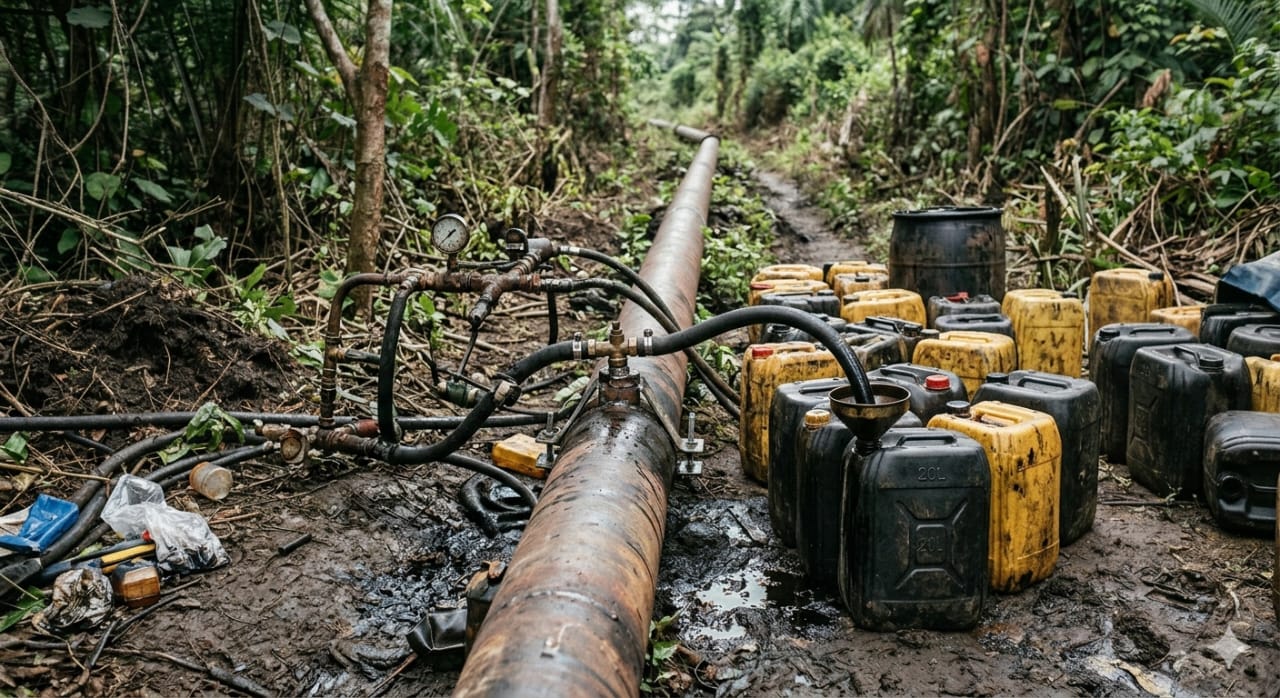
Nigeria's oil industry should be the engine of Africa's largest economy. Instead, it has become a case study in how organized theft can hollow out a nation's wealth. Between 2020 and 2024, Nigeria lost over N5 trillion (approximately $3.3 billion) to oil theft and pipeline vandalism, with peak losses hitting roughly 800,000 barrels per day at the height of the crisis.
The Army Chief raised fresh alarms in January 2026, warning that attacks on critical infrastructure still pose serious risks to the economy, this is not petty crime. It is a sophisticated, industrial scale operation that has reshaped Nigeria's fiscal position, distorted its energy sector, and left ordinary citizens paying the price.

The Scale of the Hemorrhage
At its peak in 2022, Nigeria was losing 600,000 barrels per day to theft, representing roughly one third of its actual production. The chart above tells the story: while OPEC quotas and production capacity hovered near 1.8 million barrels per day, actual output collapsed to just 1.1–1.2 million barrels per day during the worst years. The gap between what Nigeria could produce and what it actually pumped was not caused by geology or market forces. It was stolen.
Annual economic losses peaked at $6.2 billion in 2022 and remained elevated at $5.8 billion in 2023 before tapering as security operations intensified. But the cumulative damage is staggering: $25.6 billion in direct and indirect losses from 2020 to 2026. That figure does not include the opportunity cost of deferred investment, the environmental devastation of the Niger Delta, or the long term erosion of investor confidence.
Where the Money Goes
The losses are not abstract. They manifest in concrete ways that touch every Nigerian:
Direct Revenue Loss (55%): The simplest and largest component. Every barrel stolen is a barrel Nigeria cannot export, cannot tax, and cannot use to fund schools, hospitals, or roads. At $70–$95 per barrel during the crisis years, the arithmetic is brutal.
Infrastructure Damage (15%): Thieves do not gently siphon oil. They blow pipelines, rupture flow stations, and destroy metering systems. Repairing this infrastructure diverts capital from new exploration and production.
Environmental Cleanup (12%): Illegal refining sites leak crude into farmland, rivers, and groundwater. The Niger Delta suffers chronic pollution that destroys fishing and farming livelihoods, creating a secondary economic crisis in the very region that produces the nation's wealth.
Security Costs (10%): Deploying troops, naval patrols, and surveillance systems to protect infrastructure costs billions. These are funds that could have built power plants or transmission lines.
Lost Investment (8%): International oil companies have slowed or shelved projects in Nigeria, redirecting capital to safer jurisdictions like Guyana, Namibia, and Brazil. The reputational damage outlasts the actual theft.
The Budget Reality Check
Here is the figure that should keep Nigerian policymakers awake at night: the $22.3 billion lost to oil theft between 2020 and 2024 is nearly 80% of the entire 2024 federal budget of $28.7 billion. It dwarfs the education budget ($5.8 billion), the health budget ($1.4 billion), and the infrastructure budget ($4.2 billion) combined.
In other words, Nigeria has been funding a shadow economy of oil thieves instead of funding its own development. Every stolen barrel is a classroom not built, a hospital not staffed, a road not paved.
Why It Happened
The crisis has roots in governance failure, not just criminal ingenuity. Nigeria's pipeline network is vast, aging, and poorly monitored. Metering at wellheads and export terminals has been inconsistent, making it difficult to distinguish between production shortfalls and theft. Corruption within security agencies and local communities has enabled criminal networks to operate with near impunity.
More troubling, the theft has evolved. Criminal networks have shifted from remote creek operations to inland commercial hubs, embedding illegal refining within civilian markets and transport corridors
This means the stolen crude is not just exported; it is refined locally into adulterated fuel that enters the domestic market, undercutting legitimate refiners and creating a parallel petroleum economy.
The False Dawn of 2025–2026
Government officials have claimed victory, pointing to reduced theft volumes and the startup of the Dangote refinery. Theft losses did drop to an estimated 150,000 barrels per day in 2025 and 50,000 in 2026, a dramatic improvement from the 2022 peak. But this recovery is fragile.
The Army Chief's January 2026 warning signals that criminal networks are adapting, not disappearing. The underlying vulnerabilities, weak metering, porous borders, compromised security, and economic desperation in the Niger Delta, remain unaddressed. Any relaxation of vigilance could see losses spike again.
Moreover, the recovery in production volumes masks a deeper problem: Nigeria has lost market share. While it struggled with theft, competitors like Guyana, Brazil, and the United States surged ahead. Rebuilding Nigeria's position as a preferred supplier to European and Asian markets will take years, even if theft is fully contained.
The Path Forward
Fixing the economics of Nigeria's oil theft crisis requires more than military patrols. It demands a fundamental restructuring of how the sector is governed:
1. Digital Infrastructure: Satellite monitoring, drone surveillance, and real time flow metering at every wellhead and pipeline junction. The technology exists. What has been missing is the political will to deploy it transparently.
2. Community Inclusion: The Niger Delta's youth see no benefit from legal oil production. Revenue sharing, local content mandates, and direct community investment must replace the current model where wealth flows to Abuja and foreign capitals while poverty festers at the source.
3. Refining Capacity: The Dangote refinery and planned government owned upgrades are critical. If Nigeria can refine its own crude, it reduces the incentive for export oriented theft and captures more value domestically.
4. Legal and Regulatory Reform: Prosecuting high level enablers of theft, not just low level pipeline tappers, would signal that the state is serious. Asset recovery from convicted oil thieves should fund environmental restoration in the Delta.
Conclusion
Nigeria's oil theft crisis is not a security problem with economic consequences. It is an economic problem with security symptoms. The $25.6 billion drained from the economy between 2020 and 2026 represents a development catastrophe. It is the difference between a Nigeria with functional power grids, quality education, and modern infrastructure, and the Nigeria that exists today: a nation rich in resources but poor in the basic services its citizens need.
The charts do not lie. The red bars of annual losses, the widening gap between capacity and production, the cumulative mountain of stolen wealth, these are not abstractions. They are the material evidence of a state that, for too long, failed to protect its most valuable asset.
The question for Nigeria in 2026 is not whether it can stop the theft. It is whether it can stop the theft before the next generation of investors, talent, and opportunity permanently redirects toward more stable frontiers. The economics of oil theft are clear. The politics of stopping it remain the hard part.